


Hot air balloons have long captured the human imagination, dancing across the sky in vibrant colors and splendid shapes. From their earliest conceptual sketches in ancient civilizations to the dazzling spectacles seen at today’s international balloon festivals, their journey through history is a testament to creativity, daring, and our eternal desire to soar above the earth. Whether you are an avid traveler, history enthusiast, or a dreamer at heart, the story of hot air balloons offers a fascinating blend of adventure, innovation, and cultural celebration.

Early Inspirations: How Dreams Took Flight
The concept of human flight can be traced back thousands of years, with myths and legends from ancient China, Greece, and beyond. Ancient Chinese inventors, well-known for their creativity, developed simple paper lanterns filled with hot air that would rise and float, inspiring both wonder and curiosity. These “Kongming lanterns,” often used for signaling in warfare, provided a glimpse into the future possibilities of harnessing lighter-than-air technology.
In Europe, the 16th and 17th centuries saw inventors and philosophers speculating about possible ways for humans to ascend into the sky. Leonardo da Vinci’s sketches often included flying machines, hinting at a shared fascination with breaking the bonds of earth. However, it was not until the remarkable scientific spirit of the 18th century that this dream was poised to become reality.
The Pioneers: Montgolfier Brothers and the First Ascent
The hot air balloon as we know it owes much to two French brothers, Joseph-Michel and Jacques-Étienne Montgolfier. Inspired by watching laundry dry above a fire, the brothers realized that heated air was lighter than cold air and could lift objects. Their earliest experiments involved sending smoke-filled paper bags floating skyward, much to the amazement of villagers.
In June 1783, the Montgolfier brothers launched a 9-meter-high unmanned balloon in Annonay, France, paving the way for human flight. Just months later, the first living passengers—a rooster, a duck, and a sheep—embarked on a historic journey, safely landing after an eight-minute flight. It was only a matter of time before humans themselves would take to the sky.
The world watched in awe as, in November 1783, Jean-François Pilâtre de Rozier and François Laurent d’Arlandes made the first human flight in a hot air balloon over Paris, heralding the modern era of aviation.
Balloons Across Borders: Innovation and Exploration
Word of the Montgolfiers’ invention quickly spread throughout Europe and beyond. Balloons became symbols of scientific achievement and national pride. Benjamin Franklin, then serving as the American ambassador in Paris, witnessed these early flights and marveled at their possibilities, famously remarking, “Of what use is a new-born baby?”
Throughout the 19th century, hot air and later hydrogen gas balloons played pivotal roles in scientific exploration, weather observation, and even wartime communication. In the American Civil War, balloons were used for reconnaissance. Adventurers and explorers sought new records, with balloons crossing the English Channel and reaching ever-greater altitudes.
Cultural Marvels: Hot Air Balloons as Art and Entertainment
What began as experiments in physics and chemistry soon blossomed into a beloved public spectacle. Brightly colored, often whimsical in shape, balloons became a fixture at public gatherings and royal celebrations. In the Victorian era, balloon ascensions were a centerpiece of world fairs and national celebrations.
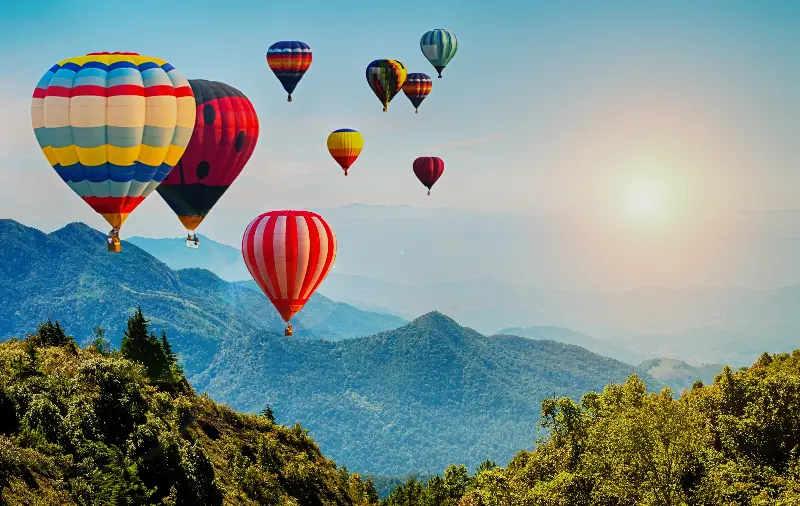
The allure persists into the modern era. Today, hot air balloons come in all hues and imaginative designs—giant cartoon characters, fantastical creatures, enormous animals—transforming the sky into a living art gallery. Pilots and passengers relish not just the flight but the sense of camaraderie and wonder that accompanies every launch.
