



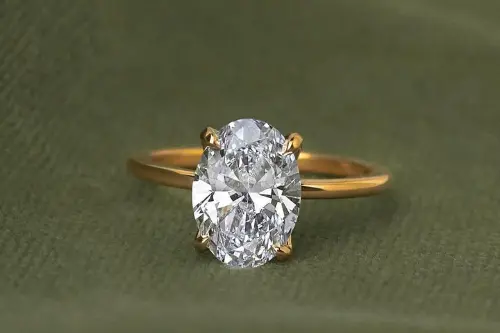
Engagement ring trends are constantly evolving, revealing striking generational differences between older millennials, younger millennials, and Gen Z.
According to Icing on the Ring, an LA-based jewelry store, older millennials largely favored cushion-cut halo engagement rings set in platinum or white gold, often featuring pave or microprong settings and sometimes a split shank design.
In contrast, younger millennials have gravitated toward yellow gold oval solitaire rings, frequently incorporating hidden halos and ultra-thin bands.
"Our younger clients are becoming more unique with their engagement rings," Rustin Yasavolian, the CEO at Masina Diamonds told Newsweek, sharing insight on the change in preferences with Gen Z clients.
The Evolution of Engagement Ring Trends
A Shift Toward Minimalism
Rustin Yasavolian, the CEO at Masina Diamonds, has observed major shifts in engagement ring trends over the past decade.
"2-3 years ago the hidden halo and simple solitaire engagement rings were the style everyone wanted.
"People don't want a ring that everyone else has. They want their ring to be one of a kind. Bezel sets, wide bands, and light colored diamonds have become the hottest trends. We've even seen wave like free form settings becoming a new trend," he told Newsweek.
He notes that the industry has moved away from white gold halo and pave band cushion-cut and round diamonds in favor of larger, chunky yellow gold engagement rings.
Social media has played a significant role in this shift. Yasavolian points out that clients are no longer limited to store displays—they browse Pinterest, mix elements from different designs, and request custom pieces, allowing jewelry designers to experiment more creatively.
Gen Z's Individuality and Ethical Considerations
Guy Cohen, Chief Marketing Officer at Keyzar Jewelry, sees a generational transformation that extends beyond aesthetics.
He provided insight with Newsweek, explaining how older millennials were drawn to cushion-cut halos in white gold and platinum, reflecting the maximalist trends of the 2010s.
Younger millennials, in contrast, embraced oval solitaires in yellow gold, prioritizing minimalism and vintage elegance.
"Now, Gen Z is pushing the boundaries further, prioritizing lab-grown diamonds, alternative gemstones, and ethical sourcing. Sustainability is a major driver, and we see more couples looking for unique, customized designs that reflect their individuality," he explained.
How Wedding Planning Reflects Ring Trends
Irene Katzias, CEO of Irene + Co Events, has observed how engagement ring trends parallel broader changes in the wedding industry.
She explains to Newsweek that older millennials tended to follow tradition, often selecting round or princess-cut diamonds in white gold or platinum.
Parental involvement was more common in wedding planning, and social media played a lesser role, while younger millennials leaned toward personalization, often incorporating colored gemstones and lab-grown diamonds for ethical or financial reasons.
"I saw more custom made rings in the past 2 years than ever before. Many of which were locally made adding to the storytelling of their proposal.
"But the difference doesn't stop at the ring. The ring is just the first step in the wedding design. I'm seeing shifts in floral choices, overall wedding design, and how couples prioritize their budgets.
"Micro weddings are on the rise since COVID and haven't stopped. The average guest count is now 80. There is a huge focus on tablescape design, proving that Gen Z's commitment to personal expression extends well beyond the ring," she said.
The Future of Engagement Rings
The Rise of Art Deco, Gender-Neutral, and Mixed-Metal Styles
Anubh Sha, co-founder of With Clarity, acknowledges the diverse engagement ring trends emerging among younger buyers.
"There's also a growing interest in gender-neutral designs and mixed-metal settings, allowing couples to break away from traditional norms and create rings that feel uniquely theirs," he told Newsweek
While ovals and yellow gold remain dominant among younger millennials, he points out that emerald and pear cuts are still in demand, along with distinctive settings such as east-west orientations.
Celebrity influence, including Hailey Bieber's oval solitaire, has significantly shaped these preferences.
Sha identifies key engagement ring trends beyond generational differences:
- Sustainability & Ethics – Lab-created diamonds, recycled metals, and ethically sourced materials are top priorities for Gen Z.
- Personalization – Custom designs, heirloom-inspired pieces, and unconventional settings are gaining popularity.
- Gender-Neutral Designs – More couples are seeking unisex engagement rings that move beyond traditional gender norms.
- Mixed Metals – Combining white, yellow, and rose gold within a single ring or pairing different metals in engagement and wedding bands is a growing trend.
The Balancing Act Between Trends and Longevity
Austin Willard, founder of Faithful Platform, has noticed similar patterns among his clients and shared his insight with Newsweek.
"Of course there will always be demand for the classic round and oval cuts, but Gen Z really favors the art deco styles like emerald cut and marquise cut diamonds," he told Newsweek
He said older millennials largely chose diamond halos with cushion or round cuts in white or rose gold, while younger millennials gravitated toward delicate yellow gold bands with round or oval center stones, often featuring diamond accents along the shank.
However, Willard advises clients to consider durability alongside aesthetics.
"Engagement rings are meant to be worn daily, and the thinner and more delicate the band, the faster the gold will wear down over time. While these styles are trendy now, we try to encourage clients to consider slightly modified versions of these trendy designs to get the aesthetic they want while ensuring their ring lasts for years to come," he concluded.