



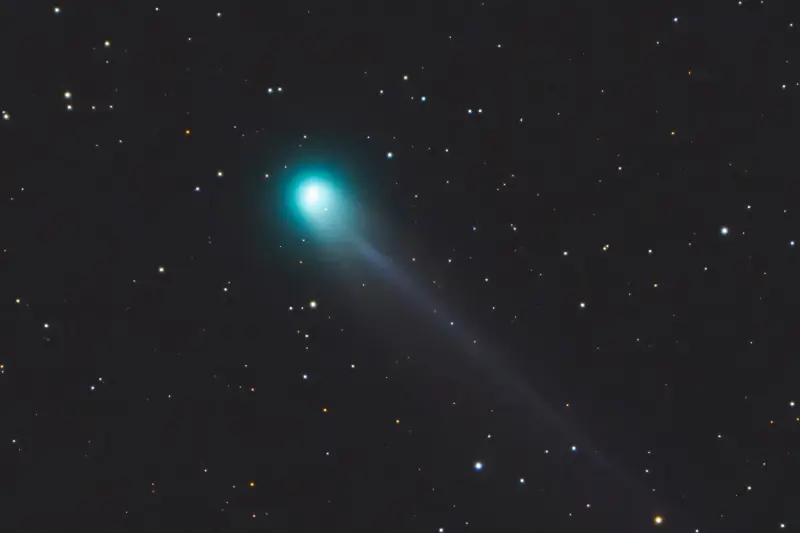
Stargazers are in for a once-in-many-lifetimes opportunity this week as a comet will be visible passing by Earth for the last time for over a millennium.
Comet C/2025 A6—also known as “Comet Lemmon”— was first discovered in January this year and is making its closest approach to our world today, October 21.
The comet may even be visible to the naked eye if conditions are right, according to the Royal Astronomical Society (RAS)—and once it’s gone, it is not expected to return to our backyeard for another 1,300 years.
Comet Lemmon’s nucleus is believed to be just a couple of miles in diameter. This is relatively small compared to other previously visible comets, such as the giant Hale-Bopp, which was visible in the skies for a record 18 months in 1996 and 1997 due to being a whopping 37 miles in diameter.
Robert Massey of the RAS told Newsweek that while it would not be anywhere near the same level as Hale–Bopp, “under ideal conditions, you can see it with your eye,” and will be “fairly easy to pick out” in the sky with a pair of regular binoculars.
“If you want to see it, and you’ve got a pair of binoculars lying around, pick those up and go have a look. You might see it with [just] your eyes, but even if you don’t if the sky is clear and you’re not near sources of light pollution, it should be fairly easy to pick out.”
Massey shared tips on how best to view Comet Lemmon as it passes close to Earth in a video posted to the RAS YouTube account on October 20.
He noted that now is the best time to see the comet, as it is closest to Earth on October 21 and closest to the sun in a couple of week’s time on November 4.
Stargazers should look into the sky after the sun has set, where the comet can be found above the star Arcturus, an orange–red object located beneath the arc of the Big Dipper in the southwest sky.
Massey advises using binoculars to identify the comet, which will appear in the sky as a “bright, fuzzy object”—but if the sky is clear and dark, it may be visible to the naked eye as well.
While Comet Lemmon may not be as impressive as Hale–Bopp, the chance to see a comet with the naked eye or simply with binoculars is unusual and well worth seeing.
Massey told Newsweek that the true size of Comet Lemmon, which he described as likely around the size of a mountain or hill, is estimated by “how much material” is left in its wake.
“This in itself is remarkable,” he said. “You take something the size of a hill, 10s of millions of kilometers away, and we can see it because we can see all the eautiful debris streaming off it and being illuminated.”
Comet Lemmon isn’t the only thing of interest in the skies this week, as it coincides with the peak of the 2025 Orionids meteor shower, which has been ongoing since October 2 and is due to end on November 7.
Meteor showers occur when the Earth passes through a debris stream in space and the Orionids are a dust trail left behind by Halley’s Comet, which returns to Earth around every 76 years and will next arrive in 2061.
As we pass through the dust trail, the meteors appear as streaks across the sky known as shooting stars.
This year’s Orionids shower is due to peak when there is a new moon, providing darker skies and ideal conditions for meteor spotting.
Do you have a tip on a science story that Newsweek should be covering? Do you have a question about space? Let us know via [email protected].