



Dials, buttons, toggles and touchscreens: Today’s automakers are offering something for everyone, whether or not they like it.
The combination of physical and digital is known as phygital, a term coined by Momentum Worldwide chairman and CEO Chris Weil in 2007. It’s been used in the technology industry since the early 2010s. The use of phygital is three times more popular today than in 2021, Google Trends search results show, and with good reason.
Technology pros, including those at car companies and their suppliers, are all trying to predict and execute the right balance of physical and digital controls for customers in a world where artificial intelligence-enhanced on-screen experiences are more capable than ever before.
“For any human-centric design, whether we are designing for aviation or for John Deere, for example, I think there’s always a certain balance that you have to meet. And something that is very haptic, something that addresses all senses, is always something that is going to be remaining in design. And it doesn’t matter which sector we are designing for. Designing for all senses is definitely something to focus on a lot,” Julia de Bono, CEO of Designworks told Newsweek.
Automakers globally began switching to digital interface-centric controls for their vehicles as a means of cost cutting and manufacturing simplicity, and to provide a connected technology experience for users. Digital control generally means that a component can be updated and/or fixed to some extent via an over-the-air update.
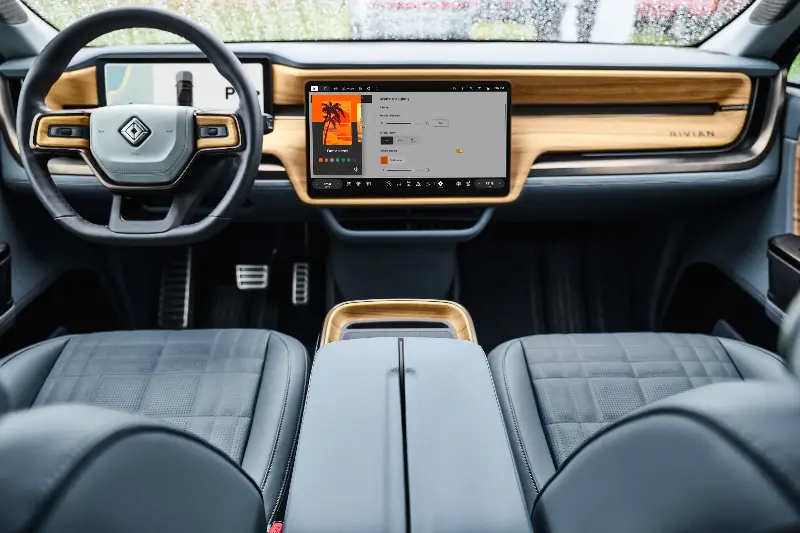
Rivian has been able to please customers with their all-digital infotainment controls. The automaker has issued approximately one update per month for its R1S three-row SUV since its debut in 2022.
American startup Slate has gone completely the opposite direction, planning to release a vehicle in late 2026 that is completely devoid of screens except a small one immediately in front of the driver, for the speedometer and backup camera view, per government regulation. Owners can install their own screen, use a tablet they already own, or rely on their smartphone for services traditionally offered by infotainment devices.
Chinese customers are asking for more screens, including those that entertain passengers, for a greater digital, less phygital in-car experience. Global models, cars sold worldwide without significant market customization, feature those screens as automakers are especially keen on holding onto market share in the world’s largest new car buyer market.
Americans, on the other hand, want different features, and are steadfast in their appreciation of phygital designs. Passenger screens did not break the top 15 most common responses in AutoPacific’s annual Future Attribute Demand Study, which surveyed 18,000 potential new car buyers. Semi-autonomous/hands-free driving capability, rear automatic emergency braking and a sunroof were the top three requested features.
Worldwide, automakers are offering front seat passenger screens in their vehicles as a means of differentiating luxury offerings from those less premium, even within their own model lineup. In North America, the Cadillac Escalade IQ, Jeep Grand Wagoneer, Mercedes-Benz CLA and Audi Q6 E-Tron are among the vehicles with them.
The new BMW iX3 is devoid of a front passenger screen despite its intended global appeal. And, though it has a screen that can control nearly everything in the car, Adrian van Hooydonk, head of BMW Group design, is quick to point out that it is a true phygital user experience.
“The car is not completely switchless. We didn’t go completely radical,” he told Newsweek. “There is, in the center console, quite a number of switches, and then there’s some that are now digital switches, but they are always visible on the bottom of the screen, always in the same location, always the right or the same size.”
Physical and digital button location is just one of the things that BMW spent extensive time testing. “We’ve done extensive studies of what functions customers need and use on a regular basis, and we made the UI accordingly,” van Hooydonk explained.
While automakers like Polestar continue to be all-in on a fully digital experience, some companies are backing away into a more phygital user experience. A few years after its Civic deployed a touchscreen-only volume control to loud consumer objection, the volume knob returned to Hondas and it has yet to leave again.
“When we design, there are certain underlying principles, logic, semantics, and I have to say they are very alike – whether I’m talking to Vanessa in the Shanghai studio or with Annette in the European studio… The semantics are really, really similar. You can have the different looks. You can appeal to a more U.S. style. You can have more European, Scandinavian style. But I think everything that is the foundation of any digital use case is [that] it should be very natural,” De Bono said.