



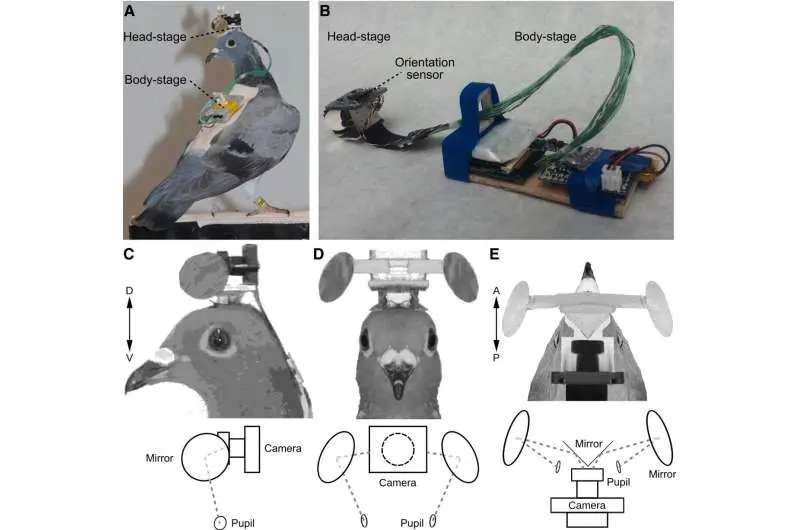
When pigeons are flying through the air, they lock their eyes in a near-fixed position instead of moving them around. Researchers from Harvard University discovered this after attaching a lightweight rig of cameras and mirrors to nine pigeons before they took off on short flights. Their findings are published in a paper in the journal Current Biology.
On the ground, pigeons rely on head movements and minor eye adjustments to look around. This is similar to how many other animals view their surroundings, but everything changes once they take off.
Scientists had long assumed that a pigeon's eyes stayed relatively still during flight, but this had never been tested until now. One reason is that it is difficult to do, but the Harvard team came up with an ingenious solution.
Getting a bird's-eye view
The rig comprised a small headpiece with a camera sensor, a lens and lightweight mirrors to track the movements and sizes of both pupils simultaneously. The pigeons also wore a small backpack housing a battery.
Of the nine birds, three flew outdoors on 100-meter (109-yard) homing flights back to their coop. During these flights, an absolute orientation sensor recorded head orientation. The other six flew indoors along a 22-meter (24-yard) corridor under different visual conditions, including sparse and dense surroundings.
So what did the researchers discover? During flight, pupil size increased by nearly 70%. A larger pupil lets in more light, and the team suggests this helps the pigeon's brain process fast-moving visual information more quickly.
In the air, their eyes barely move at all. They lock into a steady position and stay that way within about 1 degree of the same position from flight to flight. "Pigeons thus 'lock' their eyes in place by actively maintaining a near-consistent eye position within their head," the scientists wrote in their paper. This is the same no matter the visual environment, such as an outdoor setting with a natural, cluttered scene or indoors with plain or striped walls.
Why stability matters
The locked position of their eyes aligns closely with the main horizontal axes of the balance-sensing system of their inner ears. The authors think this may help the birds combine visual and balance information more effectively during flight. And this could ensure they stay on course, as the authors write, "This stereotypical eye position may help pigeons perceive self-motion critical for flight control and navigation."
Written for you by our author Paul Arnold, edited by Gaby Clark, and fact-checked and reviewed by Robert Egan—this article is the result of careful human work. We rely on readers like you to keep independent science journalism alive. If this reporting matters to you, please consider a donation (especially monthly). You'll get an ad-free account as a thank-you.
Publication details
Ivo G. Ros et al, Pigeons lock their eyes in place during flight, Current Biology (2026). DOI: 10.1016/j.cub.2026.05.064
© 2026 Science X Network
Citation: Pigeons' eyes are almost perfectly still when they're flying, study finds (2026, June 18) retrieved 18 June 2026 from https://phys.org/news/2026-06-pigeons-eyes-theyre-flying.html
This document is subject to copyright. Apart from any fair dealing for the purpose of private study or research, no part may be reproduced without the written permission. The content is provided for information purposes only.