




If machines can mimic empathy, what does that mean for truth?
AI has been quietly evolving for decades, but its sudden leap into the mainstream felt almost overnight. Not too long ago, generating text or images with AI seemed like a novelty, limited to niche tools and experimental apps. Today, it’s everywhere — from browsers and search engines to the messaging apps we use daily.
This is the next tech platform shift.
We’ve reached a point where generative AI chatbots are being used not just for productivity but as confidants, life coaches, and even as so-called “therapists.” And the danger here, too, is knowing if we can even trust information given by AI, anyway. After all, we all know AI’s tendencies to hallucinate and misinterpret. Not to mention that some AI platforms lack proper checks and balances or adequate controls over what users are allowed to generate (see The Verge’s experiments with Grok).
Trust is under siege. We’re at a point in time when, despite our access to vast amounts of information, we struggle with figuring out who to trust. AI tools can generate persuasive falsehoods in seconds, making it harder to separate fact from fiction — and easier for misinformation to spread unchecked. On the other hand, AI can also be a tool that helps surface the truth.
For Josh Aquino, Microsoft’s head of communications in the Philippines, he believes in the latter.
Fortifying truth with AI
“Trust ultimately hinges on this moment. And at Microsoft, we believe very deeply in AI’s capacity to be a force for good. And we see our responsibility in making sure that that happens right now,” shared Aquino during a recent visit to the Rappler newsroom, where he gave journalists and content producers like me a masterclass on how to use AI responsibly.
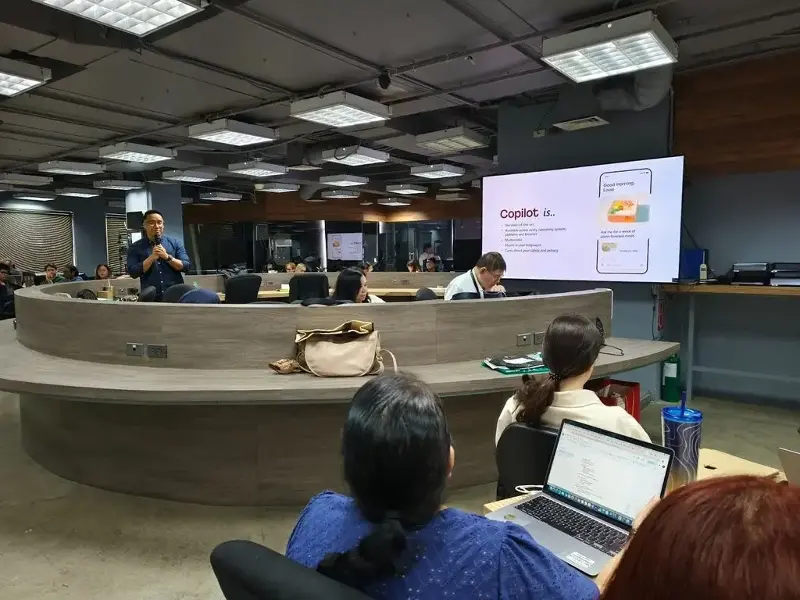
“So what’s our solution? It’s to create a chorus. Make sure you’re heard in more places at once. And AI, we believe, can be that solution. With AI, the truth can be faster than misinformation. It can be found more clearly, more pervasively,” he added.
Tech and tactic must come together. AI can help journalists respond faster, create clearer and more grounded content, and fortify truth with scale and precision. Using AI, as Aquino described it, is like having multiple swords with one hand.
Building the framework
Like with any other new tool, there will always be a learning curve. Aquino’s main advice is to continue using AI tools and determining how much of it can be responsibly integrated into your work by building the habit, the toolkit, and the culture.
To build the habit means to use AI in as many scenarios as possible and learning what makes a good prompt. A prompt isn’t just about asking questions, but rather shaping what output you expect from AI. A well-crafted prompt can turn a generic response into a tailored insight. A framework he recommends is including information about your Goal, Context, Source, and Expectations. Another framework similar to this is RISE (Role, Input, Steps, Expectation).
Once you’ve gotten the hang of crafting prompts, you can then create a toolkit where you apply tried and tested prompts in various time-based and milestone-based objectives. Think of the task at hand and find parts where AI can help you.
In writing stories, for example, AI can help craft messaging that’s more appropriate for a specific audience. AI can add a touch of emotion, critique your work, or suggest better word choices.
Then you also need to help normalize the use of AI. Help build this into your company’s culture. Share prompt libraries and success stories, and highlight leadership’s role in fostering experimentation and openness in using AI.
And lastly, make sure you’re building responsibly. Our input as experts in our fields matters greatly, and AI is just a tool that helps us (which is why Microsoft named its AI companion “Copilot”). Understand that what AI can generate is a limited view and is imperfect.
“Be better than the first draft,” shared Aquino.
How does Rappler use AI?
Rappler has had a policy on AI use in place since 2023 — a proactive move in an industry being quickly reshaped by AI. We use AI to deepen our work, not replace it. We disclose when it’s used, and we train our newsroom to engage with it critically.
Our chatbot, Rai, is a reflection of that. Rai is a tool that readers can use to ask questions about any subject. It is grounded in curated facts, designed to assist, not mislead.
While Microsoft champions AI as a co-pilot, Rappler puts that into practice — proving that when guided by values, technology can help us tell deeper, truer stories. – Rappler.com