


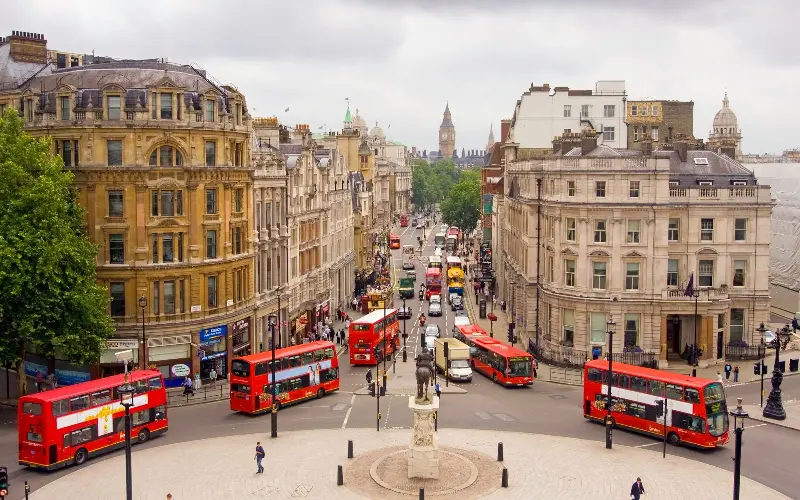
Whether you’re simply trying to get from A to B, or eager to soak up a dose of London at its most authentic, making use of the city’s extensive public transport network – whether by bus, bicycle, train, tram or boat – is an essential part of any visit to the British capital.
It is also a pleasure all its own: take sitting on the top deck of the 159 bus as it swings over Westminster Bridge, for example, trundling towards the newly gleaming Big Ben, the windscreen perfectly framing the majesty of the Palace of Westminster (perhaps better known to tourists as the Houses of Parliament).
It’s also usually the most efficient way to get around.
After a lovely day on Hampstead Heath, it might be tempting to hop in a cab to those dinner reservations in Bermondsey – but you’d be foolish to eschew the Northern Line, on the Underground, which will likely get you there in half the time (and at a fraction of the cost).
It is vast, however: the Underground – known in other places as metro or subway, and usually referred to by locals as the Tube – alone comprises 11 lines and 250 miles (400 km) of track, and covers Greater London, as well as parts of the neighbouring counties of Buckinghamshire, Essex and Hertfordshire.
There is, therefore, no shame in requiring a little help in getting to grips with it. Here we break down the best ways to plan your journey, pay for tickets, and avoid the crowds.
How to get to and from London’s airports
Types of transport
Transport for London (TfL) is used by approximately 4million travellers each day – and that’s just on the Tube. All the services across TfL’s network are designed to complement each other, and are intended to be used together.
Tube
London’s 11 lines run from 5am to midnight Monday to Saturday, with slightly reduced hours on Sunday. The Night Tube runs on some lines on Fridays and Saturdays. Fares are based on the distance and time travelled, and start at £2.80. It is essential to tap in when you pass through the gates to enter, and to tap again when you exit. (See payment advice below.)
It’s also worth bearing in mind that the Tube has been around since 1863, and – as the world’s oldest underground passenger railway – sometimes, it shows. This can be a positive – as in the beautiful jewel-coloured tiles at Russell Square and Covent Garden stations, which are well over 100 years old – or not. Things break, and leak, often.
Elizabeth Line
Launched in 2022 and named for the late Queen (though often referred to by locals as the “Lizzie line”), this runs east-west across Greater London, terminating at Heathrow Airport or Reading in the west, and Abbey Wood or Shenfield in the east.
This is a fast and good-value way to travel to central London from Heathrow, and can also be used at the airport to transfer free of charge between Terminals 2 & 3, Terminal 4 and Terminal 5 (note: you will have to tap in and out, but won’t be charged).
Bus
London has nearly 9,000 buses running across more than 670 different routes, with fares starting at £1.75. Some routes run all night, though less frequently, others run from roughly 6am-1am, so do check the operating hours.
You pay by tapping on the yellow card-reader by the driver as you enter the bus (you don’t need to tap when you exit).
Docklands Light Railway (DLR)
This system serves the East of London, connecting the city’s two financial hubs, the City of London and Canary Wharf. Fares and payment are the same as on the Tube.
Overground
The six lines of this rail network connect London to many of its suburbs; fares and payment are the same as for the Tube.
National Rail
This is the organisation that sends trains all over the country, including to Gatwick Airport. Buy tickets in stations or online and insert/tap them when you go in and out of the barriers as on the Tube.
Tram
This light rail tram system serves parts of South London, where there are fewer Underground stations than in the North. Fares and payment are like buses.
Santander Cycles
Once, and sometimes still, referred to as “Boris bikes”, after the London mayor who made them popular, these can be hired from docking stations around the city for as little as £3.50/24hrs (the dockless electric Lime bikes you will see around town, by contrast, charge a £1 unlock fee plus 29p per minute, £3.99 per 30 minutes, and £6.99 per 60 minutes).
Make sure you’re ready to cycle on the left side of the street and follow all traffic laws. London cyclists are aggressive, as are drivers, so do take a look at the cycle lanes if you’d prefer to plan a quieter route.
Find more advice on cycling in London here.
Riverbus
Skip the traffic and take in spectacular views on London’s water bus service; this is particularly good for zipping between Westminster and the Tower of London, or Borough Market.
Unlike pricer river tour boats, Uber Boat by Thames Clippers does not offer guided commentary, but it does get you to many central spots between Putney and Woolwich from just £5.90.
You can save nearly a third on standard fares (purchased at the piers) if you buy your tickets online or pay with contactless or an Oyster card.
Cable car
Costing from £13 for an adult ticket, London’s IFS Cloud Cable Car takes passengers from Greenwich to the Docklands and on to the ExCeL Center, all in the East of the city, offering spectacular views.
How to pay
Oyster cards
Using a prepaid Oyster card (a small plastic payment card) is often better value than buying a Day Travelcard (paper ticket), and is the best choice for most visitors. You can choose how much to put on each card, and top up at stations or online. Oyster cards have daily and weekly spending caps (for example, if you travel in Zone 1 only, the daily maximum is £8.90 for unlimited rides, and the weekly cap is £44.70). Remember: one card per person, tap in and out.
Alternatively, you can order a Visitor Oyster in advance to be sent to your house (including international addresses), pre-paying as much as you like; the balance never expires. Do bear in mind that each passenger must have their own card, however, and that the Visitor Oyster cannot be purchased in London.
Contactless
Tapping in/out with a physical bank card or one saved on your phone works on all public transportation, and fares are automatically capped on a daily or weekly basis, so you always pay the minimum fare. However, if your bank card was issued outside the UK, check whether transaction fees or bank charges apply for each tap.
It’s also important to remember that each person in your group must tap in/out with a different card (ie. you cannot pay for multiple people with one bank card).
Paper tickets
You can buy single or return tickets at machines in Underground stations. These are best if you do not plan to travel frequently, or if you need a paper receipt for business expenses reporting.
Paying for children and pets
Under the age of 11, children can travel free on public transportation; they can go through the wider gates of the Underground with a fee-paying adult. Children ages 11-15 can travel for free or at a significant discount with a Young Visitor Oyster. There is no charge for pets.
Planning your journey
Journey planning apps
Google Maps and Transport for London’s own planning app are both useful resources – but, in my experience, it’s Citymapper that typically offers the most efficient plans, with excellent up-to-the-minute information on delays (which are frequent).
Don’t forget to walk
London is one of the world’s great walking cities; there is much to be seen on the streets. But choose your time on foot judiciously: try one of our expert’s 10 best walking routes, choosing between a turn around the Royal Parks, a meander through the legal backstreets, or a section of the 184 mile-long Thames Path, that follows the winding river.
Accessibility
If you are traveling with a pushchair (stroller), bear in mind that each bus is restricted to two on board at any time, so you may have to wait for the next bus. Pushchairs are a common sight on the Tube, but not all stations have lifts, so plan ahead to avoid having to ask for help getting up and down stairs.
Similarly, wheelchair users can access buses via the rear door ramp, but do check in advance to ensure that you will be able to access your chosen Tube platform step-free, as well as for transfer access on your planned route.
TfL has a step-free Tube map, and its journey-planning app and website have a step-free filter.
Tips and tricks
- Avoid rush hour (roughly 7.30-8.45am and 5-7pm) if at all possible – trains and buses will be especially busy.
- Always check in advance whether a station is open; for example, Holloway Station (Piccadilly Line) closes when there are football matches at the nearby Emirates stadium, because it cannot handle the volume of fans, who are diverted to nearby Arsenal or Highbury & Islington stations in the hours before and after a match.
- Pickpocketing is a common problem on London’s public transport, so keep an eye on your belongings and ensure any bags are securely closed.
Transport etiquette
Priority seats
At the front of buses and close to Underground train doors you will notice priority seats. These are intended for people with mobility challenges, disabilities, invisible impairments, pregnant women, or those with other conditions or illnesses that make it difficult to stand.
Transport for London issues blue badges (or “Baby on Board” badges for pregnant women) for people to wear to indicate that they would like to be offered a seat, but it is also customary to offer seats to the elderly. Priority seats are not reserved for children, and children should be prepared to proactively give them up.
Escalators
Stand on the right, walk on the left. Locals get very grumpy when tourists do not follow this protocol.
Corridors and stairs
Walk on the left-hand side.
Wait for others to exit buses and Tube cars before you enter: You will hear announcements to this effect, and locals strictly follow this flow of traffic by standing to either side of an open Tube door and ensuring that everyone has left before they board.
Queuing on the platform
There’s a subtle queuing system while waiting for trains or buses, particularly at busy times; note who was there before you and don’t jump the queue.
It’s not a cafe: It’s generally frowned upon to eat on the Tube or bus, particularly if it’s fragrant food – though you are likely to see young people necking beers or tinned cocktails at weekends.
Travelling with animals
It is not unusual to see cats in carriers, or dogs on buses, trains or Tube cars. Make sure that your dog is kept on a lead at all times and under control. Ask the owner before stroking a dog; animals can be nervous in crowds.
Phone calls and headphones: A topical issue – so-called “bare beating” (listening to music without headphones or talking loudly on the phone in public) is rife on TfL, but should be avoided if you want to avoid judgemental stares.
How to get to and from London’s airports
Getting to and from Heathrow, Gatwick, City, Luton and Stansted is often faster – and dramatically cheaper – if you travel by public transport rather than by taxi (though you should always check whether there are planned closures on the line you plan to use ahead of time).
Here are the best ways to travel to London’s airports:
Heathrow
Sitting to the west of London, Heathrow is the city’s biggest international airport – and the fourth busiest in the world.
You can reach it via National Rail, the Elizabeth Line, and the Piccadilly Line on the Underground.
The fastest option is the Heathrow Express, which goes to London Paddington in under 20 minutes, every 15 minutes, but this is also the priciest option, at £25 for a single journey.
The Underground journey can be long, especially if you are going to East or North London, but costs from £5.80. The bus would be cheaper still, but might take quite some time. If they are within reasonably easy distance of one of its stations, most Londoners will opt for the Elizabeth Line – which costs £13.90 for a single journey between Paddington and Heathrow, taking between 23 and 27 minutes.
Gatwick
London’s second-busiest airport, Gatwick, lies 30 miles south of the centre of town, in the country of West Sussex. The Gatwick Express train (from £21.50 one way) runs every 15 minutes from London Victoria to the airport, and at 30 minutes is the fastest option. There are other (cheaper) National Rail options too, however – run by Southern and Thameslink from several central London stations.
City
London City Airport is the smallest and most convenient airport for short-haul flights, sitting just 6 miles east of central London, not far from Canary Wharf; unsurprisingly, it sees lots of business travel.
It has a stop on the Docklands Light Railway (DLR), which then connects to the Underground system at Canning Town, Stratford and Bank stations, where you can change for the line you require.
Stansted
London’s third-busiest airport, Stansted, sits 42 miles northeast of central London. The fastest way to get to the centre is on the Stansted Express (tickets from £9.90 in advance), which runs every 15 minutes to Liverpool Street station; the journey takes 47 minutes, or you can change after 30 minutes, at Tottenham Hale, for the Victoria Line.
Luton
London’s fourth-busiest airport is 34 miles north-west of London’s centre, in Bedfordshire. Thameslink operates services to London Bridge, Blackfriars, and St Pancras International.
The Luton Airport Express runs every half hour, with a journey time of 23 minutes to St Pancras station. You can buy tickets in advance for as little as £10, including the four-minute transfer on the Luton DART (Direct Air–Rail Transit).