


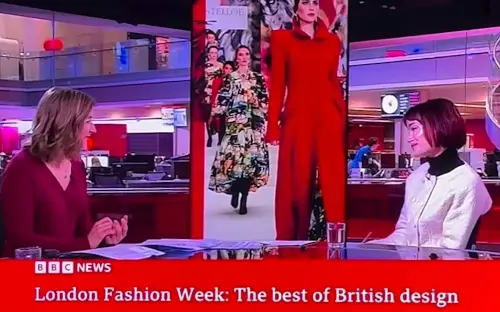
Everyone who works in fashion has been at the receiving end of The Look. Usually it happens during a party or at a dinner that’s not industry-related and someone asks what you do. You reply, and that’s when they hit you with it. The slightly patronising stare that says, “Ah, you’re a bit frivolous”. Silly, even. Fluffy.
The one time you don’t expect to get The Look is during an interview with BBC News, but that’s what happened to Vogue’s Julia Hobbs when she was brought into the studio on Sunday to discuss London Fashion Week. At the end of her segment, during which she had happily discussed the creative, thoughtful collections that had been shown over the last five days, the presenter turned to the camera and said, “Now onto something that’s slightly less fluffy”.
Quickly, she tried to correct herself, adding, “Or fun I should say”, but the impression remained that London Fashion Week was not real news – and for anyone who works in what is a hugely profitable and influential industry, it stings.
“It’s sad and insulting because the fashion and beauty businesses are worth a combined £60 billion to the economy, employing hundreds of thousands of workers at all levels,” says renowned hairdresser Sam McKnight, who also posted a clip of the interview to Instagram and received supportive comments from major industry names including Caroline Rush and Jo Elvin. “It’s a huge soft power culturally and globally for the UK. The British Fashion Council and the British Beauty Council work so hard to elevate the perception of our industries, and to hear a newsreader call it fluffy is disappointing and disrespectful.”
Fashion sits at the intersection of art and business – it’s creative but it also makes a lot of money. And while painting, sculpture, music and theatre are all seen as worthy parts of our artistic culture, fashion, largely, is not.
You’d think, then, that it would be taken seriously as a business proposition – but that is also often not the case. “On the part of the BBC presenter it is lazy journalism,” says Tamara Cincik, founder of think tank Fashion Roundtable, who argues that fashion as a whole is portrayed as out of touch or irrelevant when it is anything but.
“It is more than just London Fashion Week which is just a tiny percentage of an industry,” she says, underlining that the multi-billion pound sector “includes delivery drivers for our online purchases, sustainable micro businesses, manufacturers who stepped up to help make PPE in Covid and retailers on our high street who are struggling with the NICs increase and competing with online offshore retailers.”
Part of the problem is that fashion is powered mostly by women and gay men. Football – a predominantly male interest – is rarely seen as a frivolous preoccupation, even though you could argue that kicking a ball up and down a field is less cerebral than, say, designing a collection with commercial appeal which nods to the wider culture. The people who work in football aren’t dismissed as silly, and we all know that a BBC News presenter is unlikely to end a segment on the World Cup with the word fluffy.
And while one slip on television is not going to change anyone’s life, moments like these point to a wider perception problem – one that can cause huge damage when it ends with the government failing to see fashion as an important industry that needs its support.
This became evident to me in 2021 when I wrote about the problems designers were experiencing in the wake of Brexit. Trade agreements meant that for something to be tariff-free it had to be wholly made in Britain; given we have, for example, no zip factories this was nigh on impossible and small fashion brands were paying the price. But the more I researched it, the more I realised that the national conversation was elsewhere. On fisheries (annual revenue: £1 billion) or cars (annual revenue £18 billion).
This is a cultural choice that Britain makes. “I am in Milan at the moment, where the government and press take fashion very seriously, and look at how successful it is,” says McKnight. “It may look like fun, but it takes an army.”
In France, too, fashion is viewed as an industry that must be given everything it needs to thrive. The result? LVMH is the most profitable listed company in Europe, and its chairman Bernard Arnault, who lives in Paris, the on-off richest man in the world.
“The reality is that there are huge issues in British fashion which need attention, so we can bring jobs and manufacturing back to the UK and stem the tide of fast-fashion over-saturation,” says Cincik. “If the BBC cannot see that, then we need journalists to be educated in our value – people who appreciate that if the sector makes more than aviation, pharmaceuticals and automobiles combined, that’s not fluff. That’s business.”