


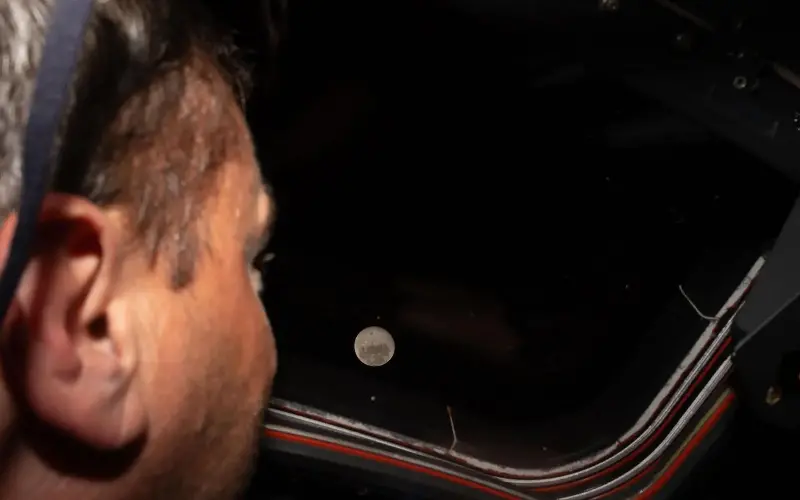
Humanity has pushed deeper into the void than ever before.
After a six-day journey to the Moon, Nasa’s Artemis II mission reached the farthest point from Earth that humans have ever gone – a staggering 252,760 miles from home.
It is a significant achievement. The distance is equivalent to flying from London to Sydney 23 times in a row, and is more than 4,000 miles further than the previous record, set by Apollo 13 during its emergency return to Earth in 1970.
It is a dark, lonely spot where the vast rocky bulk of the Moon cuts off the astronauts from Mission Control.
During the blackout on the far side, no human crew has ever been so far away from home, and so alone.
The feat is all the more impressive because space is out to kill us.
A toxic cocktail of radiation and isolation, combined with a lack of basic human requirements such as air, water and pressure, means venturing this far away from our planet is treacherous.

In fact, no human has left low Earth orbit – the region of space closest to our planet, typically extending from 160 to 2,000 kilometres (100-1,200 miles) above the surface – since the last Apollo mission in 1972.
If you are younger than 54, you have not experienced a world in which Moon travel is possible until this month.
After the US beat the Russians to a lunar landing in 1969, interest in the space race waned, and the remaining Apollo missions were cancelled, with funds redirected to domestic programmes, the Vietnam War and the Space Shuttle.
The Space Shuttle only managed a maximum distance of 386 miles above Earth – when it deployed the Hubble Space Telescope in 1990 – and largely stuck to ferrying astronauts to the International Space Station (ISS).
Most astronauts, therefore, have never travelled further than the ISS, which orbits 250 miles up. To put it in perspective, the Artemis II crew is 1,000 times further away from Earth than the astronauts in the ISS.
In fact, the ISS is so close to Earth that astronauts do not even experience true zero gravity.
Gravity on the space station is only slightly weaker than Earth – about 90 per cent – but the weightlessness they feel is caused by the ISS being in constant freefall around the planet.
It does not crash because it goes fast enough that the curve of its fall matches the curve of Earth’s surface.

In 2024, SpaceX’s Polaris Dawn mission went slightly further into space, reaching 870 miles above Earth – a record for recent times – but the Moon is 290 times further away.
So why have we not ventured further afield until now? Well, there are good reasons not to go too far.
Earth is surrounded by a protective magnetic bubble known as the magnetosphere, which shields our planet from deadly solar and cosmic particle radiation.
It is generated by the movement of charged, molten iron, far below the surface in Earth’s outer core, deflecting lethal particles before they can do any damage.
The magnetosphere does not have a hard, fixed edge, but a shifting boundary known as the “magnetopause” which stops around 40,000 miles from Earth on the side facing the sun, and 100 times further on the nightside.
Anything in low Earth orbit such as the ISS and the Hubble Space Telescope, is significantly better protected from space radiation.
In contrast, for the majority of its orbit, the Moon remains outside Earth’s magnetic field and is directly exposed to the full force of the solar wind and energetic solar particles.
Astronauts outside Earth’s protective shield, such as the Artemis II crew, are in serious danger from radiation, which can lead to DNA damage, cancer, cardiovascular disease, cognitive impairment, tissue damage and cataracts.
Research has shown that the Apollo astronauts who travelled outside the magnetosphere were four times more likely to have died from cardiovascular disease than those who went into low orbit, or never left Earth, likely because of cosmic ray exposure.
The Artemis crew capsule, Orion, is designed to protect astronauts from space radiation more than the previous spacecraft that carried humans to the Moon.
But the astronauts are still still taking a big risk. As well as the usual space radiation, the sun could also release a solar flare, or coronal mass ejection (CME), either of which can fling even more dangerous particles into space.
In the days before the launch, the sun was worryingly active, producing a number of solar flares which threatened to impact lift-off.
Extended periods on zero gravity can also lead to serious health issues, including bone density loss, muscle deterioration and blood clotting.
More than half of astronauts suffer vision problems from fluid moving towards their heads.
So it is little wonder, that, until the Artemis II mission, there has only been a four-year period in human history where we ventured beyond our protective bubble.
In short, space makes the top of Everest or the bottom of the Mariana Trench seem hospitable. Which begs the question: why go at all?

When Capt James Cook asked what drove him to sail to Australia he said: “I had ambition not only to go farther than any man had ever been before, but as far as it was possible for a man to go.”
Humanity is a restless race, with a pioneering spirit that is seeking to find out what is beyond the next horizon.
This time, humanity is not only going to the Moon to explore, but to work out a way to stay.
Within two years, Nasa plans to land astronauts on the lunar surface, and wants a permanent base established by 2030.
So when the Artemis II astronauts see Earth rise from behind the Moon, it will signal not just a new day, but a new dawn in spaceflight and the history of humanity.
We are slowly venturing further and further out, learning how to protect ourselves, how to survive and even thrive in the rigours of space.
We are evolving to be a multi-body species.
In the future, space may no longer be out to kill us. It may be somewhere we call home.