


Let’s be honest. If there’s one kitchen appliance that gets unfairly treated, it’s the freezer. Escaped peas ricochet around the drawers (slowed down only by the blanket of fish-finger crumbs). Ancient unlabelled Tupperware (storing leftovers from at least a year ago), hides amongst oven chips and unloved loaves of bread. There’s one drawer you’ve abandoned, so full to the brim and iced over it would take a pick-axe and the world’s strongest wrists to prise it out.
This isn’t how it needs to be. That unloved freezer can be your secret weapon in the kitchen (especially in the run-up to Christmas), saving you serious cash and bringing you joyful, tasty meals (without a beige buffet in sight). I know this because I’ve spent the last five years helping thousands of people unlock the brilliance of their freezer.
Don’t believe me? Here’s what you need to know.
Clear down, defrost and organise
First things first, we need to address what you’ve got. If you’re currently just storing some ice lollies and a box of fish fingers, you can skip ahead. But if your freezer is stuffed to the brim and frosty enough to house penguins, you’re going to have to do a little work (it might not sound fun, but this is so satisfying).
Here are the steps you need to follow…
Step one
Clear out the freezer
One drawer or shelf at a time (or a bag’s worth if you have a chest freezer), let’s have a clear out:
- Remove ice packs or bags of ice that you are not actively using. Instead, store your ice packs in your cool bag, then just chill them when you need them (note you may need these for step three – defrosting). As for the ice, there are much better options for cooling your drinks (more on this later).
- Remove excess packaging. This could just be a case of trimming boxes or bags down, or you could move your food into resealable freezer bags and ditch the original packaging altogether. Just be sure to label your freezer bag and hold on to any cooking/allergen advice that you might need.
- Remove unloved foods. Identify the foods you know you’re never going to eat and get them cleared out. This doesn’t have to mean throwing them away. If there are foods you are just not keen on, offer them to family, friends or neighbours – or use the food sharing app Olio to pass them on to someone local to you.
- If you have foods that are freezer burnt (icy and mottled), this isn’t a sign that they’re spoilt, just dehydrated, so you can eat them (as long as they don’t appear “off” in anyway once they’re thawed/cooked – never eat anything you think could make you sick). You may want to use any freezer-burnt items in dishes such as curries or stews to help disguise the poorer quality.
- If you do find foods that are beyond saving, dispose of these in food waste or compost, then recycle any suitable packaging.
Step two
Categorise and contain the contents
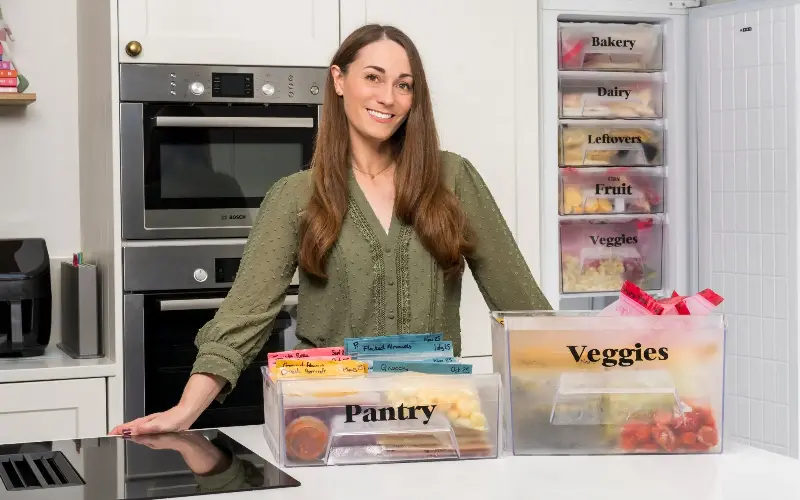
Once you’ve cleared out the clutter, take a look at what’s left and organise this into categories. My freezer contains bakery, dairy, pantry, leftovers, vegetables, fruit, raw meat and fish.
Use containers such as cardboard boxes, plastic tubs and tins to carve up your freezer space if necessary (you can of course buy containers or drawer dividers if you prefer, but what you need might change, if you follow my tips below).
Raw meat and fish should always be at the bottom of your freezer and away from ready-to-eat foods to avoid cross-contamination, but you can otherwise decide for yourself where you want to locate your different foods.
Label or colour-code the spaces so that it’s clear to everyone in the house where each food type lives. It might seem crazy, but this makes it so much easier to find foods easily, and will help to stop you buying more than you need of a particular food type.
Step three
Defrost the freezer
Whilst our freezers would ideally be empty before we defrost them, this is rarely practical. Luckily, it is possible to keep our food safe, and defrost quickly, with minimal effort. On a cool day, transfer all of your frozen food into insulated bags or a box (I’ve been known to use a plastic laundry basket), along with any ice packs, arranging the food together as tightly as possible with anything small or delicate in the middle. Remember to keep any raw meat/fish away from ready-to-eat foods. Cover with a blanket to help insulate it.
Now turn off your freezer, grab some old towels and boil your kettle. Lay the towels along the bottom inside of the freezer (I usually put my freezer trays on top too to catch the ice), and carefully place bowls of hot water throughout the freezer.
Shut the door and leave it for around 15 minutes. You can take this time to give your drawers a wash if you have any.
When the 15 minutes are up, you should be able to use a plastic scraper to knock away any remaining ice, then wipe down the inside with a clean tea towel. If there are stubborn patches, simply repeat the hot water until it’s cleared.
Switch your freezer back on, then once it’s cooled back down you can start to restock it.
More tips and tricks
The optimum freezer capacity
Did you know we should be stocking our freezers to about 75 per cent full, so that they can run more efficiently?
Too empty and they have to work harder to stay cold (so they’ll cost you more money). Too full and the freezer has to work harder to try and circulate the cold air (costing you more, putting food at risk, and potentially causing damage to your freezer).
Building your freezer stash
If you’re currently wasting a lot of fresh food, this may surprise you: you can freeze almost everything.
Sure, some foods will need to be used in a different way (your frozen rocket won’t be great for salad, for example, but it’s perfect for making pesto), but you can absolutely use your freezer to press pause on ingredients to stop them going in the bin.
Considering the average four-person household wastes £1,000 every year throwing away food they could have eaten (according to Waste and Resources Action Programme, Wrap), using your freezer in this way could save you some serious cash.
Before you start just lobbing everything in the freezer, it’s worth using a few simple techniques so that your food is easier to use later and takes up less space…
Open freeze
The method of freezing food spread out on a lined tray before moving it to a freezer bag. Useful for foods that are otherwise likely to clump together and form a “foodberg” (such as cut-up fruits and veg, or leftover tinned foods such as chickpeas). If you’ve ever had to smash a bag on the counter to break up the contents, or defrost the whole lot just to use a handful, this technique means you’ll have free-flow food and you can just grab what you need (often to cook straight from frozen).
Flat freeze
If you have any “wet” or “soft” leftover ingredients, such as tinned tomatoes, coconut milk or hummus, you can freeze them flat in usable portions in a labelled freezer bag. It takes up less space in your freezer than a tub, and you can defrost the contents far quicker by submerging the bag in cold water. A handy way to store leftovers or batch-cooked meals.
Cube freeze
For soft foods that you only need small quantities of (such as pesto, tomato puree or curry paste), freeze any excess in an ice-cube tray, then move the cubes to a freezer bag once they’re solid.
Using freezer bags for storage is my preference because they are flexible and you can fit more into your freezer than containers. Using good-quality bags is key though, so they can be washed and reused as much as possible. Keeping a couple of permanent markers in your kitchen drawer is the best hack to overcome the dreaded UFO. (Unidentified Frozen Object), and if you soak your freezer bags you should find the pen washes off so you can relabel them.
Freezer essentials for your stash
Fruit
Browning bananas, slightly squishy berries, that half-eaten apple… any fruit at risk of being binned goes into the freezer to make into ice cream, or smoothies, or just to snack on frozen. I am a big fan of using frozen fruit instead of ice cubes (I told you I had a better option!); I always have slices of lemon, lime or orange in my freezer ready to chill drinks.
Vegetables
Any “at-risk” veg gets frozen too. Technically, you should blanch them before freezing (putting them in boiling water, then ice water), as this stops enzymes that deteriorate the veg and kills bacteria, but if you’re not planning to store it for too long then you can skip this step as long as you wash the veg thoroughly. I find it’s always worth blanching denser vegetables such as sweet potatoes, as they’ll cook faster and more evenly.
Herbs and aromatics
Herbs retain their flavour really well in the freezer and they take up little space. You can’t use them as a garnish, but chucked straight into whatever you’re cooking they work perfectly. Garlic, ginger and chillies can also all be frozen whole and then grated or crushed straight into your dish.
Excess pantry items
I’ve lost track of how many jars, tubes and tins have been half used in our house, stored in the fridge and then binned (sound familiar?). Now anything that isn’t fully used gets frozen. Nuts, beans, pulses, pesto, tomato purée… all of them are frozen for a future meal so nothing goes to waste.
Items it’s handy to know you can freeze
Sandwiches
A great way to avoid any bread or cooked meats from going past their best. You can’t put salad on them, but standard fillings such as ham and cheese work really well. Perfect for making mid-week lunchbox packing quicker, or pop one in the air fryer for a quick toastie lunch.
Eggs
Never in their shells, but break them out and you can freeze just the whites, the yolks (with a pinch of salt or sugar) or the whole egg whisked up. I freeze them flat in usable portions so I can defrost quickly in cold water, then use as normal (making sure they’re fully cooked).
Wine
If you can steal a glass away, freezing the liquid is helpful for recipes (such as risotto) that call for a splash of wine but you don’t want to crack open a bottle.
The Full Freezer Method by Kate Hall is published by Ebury Press (£14.99)