




If successful, this type of battery could become the ideal energy solution for long-term space missions, where humans cannot intervene for centuries.
The US National Aeronautics and Space Administration (NASA) is testing a new generation of nuclear batteries using the radioactive isotope americium-241, with a potential lifespan of up to 433 years.
If successful, the battery could become an ideal energy solution for long-duration space missions where humans cannot intervene for centuries.
Energy for journeys beyond reach
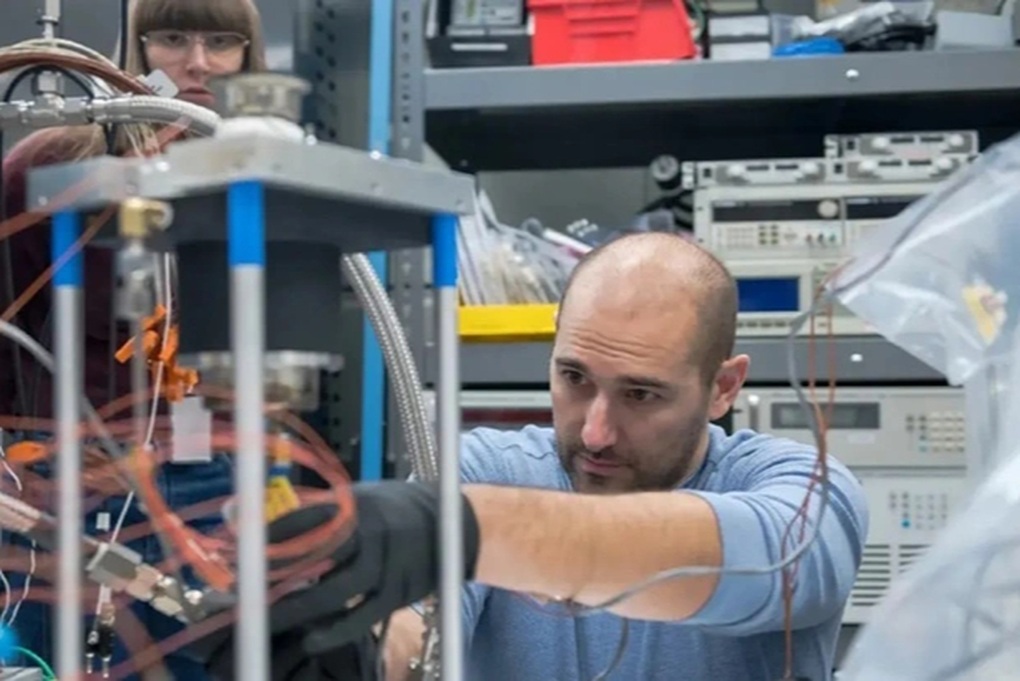
NASA engineers adjust the Stirling engine during testing (Photo: NASA).
According to Interesting Engineering , outer space is a place where there is no power grid, the sun is too far away or obscured by a thick atmosphere, and the temperature is bone-chillingly cold.
Under those conditions, to maintain the operation of spacecraft and exploration equipment, NASA has used nuclear battery technology for decades.
This type of battery works on the principle of harnessing the heat generated from radioactive decay to generate electricity. This technology has been applied in famous missions such as Voyager 1 and 2, New Horizons flying past Pluto, or Mars exploration robots such as Curiosity and Perseverance.
For decades, NASA has primarily used plutonium-238, an isotope with a half-life of about 88 years.
However, supplies of plutonium-238 are limited and production was halted for 30 years. Although production resumed in 2011 at facilities such as Oak Ridge and Idaho, supplies remain insufficient to support the growing number of space missions.
Faced with that reality, since January, NASA has been working with the University of Leicester in the UK to test a potential alternative, americium-241.
This isotope has a half-life of up to 433 years, which is nearly five times that of plutonium-238. That means a device using an americium-241 battery can operate stably for hundreds of years without replacement or technical intervention.
This is unprecedented in the history of the aerospace industry.
When life is no longer a limit
Batteries using americium-241 not only have a long life, but are also capable of providing stable power for long periods of time without significant degradation.
This is especially important on deep space missions, where signals from Earth take hours or even days to reach the probe.
Once the equipment is gone, humans can no longer repair or resupply it, so energy needs to be sustainable, reliable, and operate independently for decades, even centuries.
Previous space missions typically only required equipment to operate for about 14 years, according to Wayne Wong, head of thermal energy conversion at NASA's Glenn Research Center.
But with americium-241, NASA can design devices that will operate for hundreds of years, enabling research programs to last from generation to generation.
Of course, to be used in harsh environments like space, americium-241 must meet extremely strict standards for safety and stability.
The radioactive isotope used must be insoluble in water, non-toxic when in contact with living organisms, and especially must have a stable physical structure.
Radioactive fuel is often made in ceramic form so that if an accident occurs, it will break into large pieces, limiting release into the environment and reducing the risk of absorption through the skin or respiratory tract.
The process of processing and refining americium-241 is currently being carried out at the Los Alamos National Laboratory in the United States, which has the world's leading nuclear safety system.
In parallel, NASA is also testing the free-piston Stirling engine. This is a highly efficient system that converts heat energy into electricity, and can operate for 14 years without maintenance.
The combination of americium-241 and Stirling technology promises to create a nuclear battery that is not only long-lasting but also extremely compact, suitable for space-limited probes.
Opening the future for century-long missions
If the testing goes well, americium-241 could become a key fuel for future space exploration missions.
The Dragonfly drone, scheduled to fly to Saturn's moon Titan later this decade, could be one of the first devices equipped with a new generation of nuclear batteries.
Not stopping at space, this type of battery also has potential applications in many other fields such as deep-sea sensors, measuring devices in extremely cold environments, or telecommunications systems that do not require maintenance for decades.